Powered By Blogger

Saturday, 31 December 2016

Mise en scene in the cellar

Mise en scene

When filming our opening seen we wanted a large amount of focus to be put on the mise en scene, especially the props and lighting as we belived this would be the most effecive way to portray the film genre as well as hinting at where the story of the film was going to lead. 

Props

We had previously done a significant amont of research into religous symbolism which benefited us during the process of choosing our props to include in our sequence as it provided us with an idea of what would work. We gathered bibles and many candles as they would portray a clear religious asthetic. 
Within the house of the artists, we discovered several items
which we belived would be perfect for our set and to help produce the eery atmosphere we were aiming to acheive. We found these old books, (shown in the picture beside), which were extremely tattered and had several symbols on them. We thougth they complemented our film genre suitably so we added them to our set. Beneath them is an old wooden box which we also found amongst the items in the house. We thought this also complemented the theme we were going for and I was please with this find.


We placed a candel next to the accumilation of books and the bible which, I belive, transformed the set into soemthing much more eerier and spookier to look at. The candle had a metal holder which had intricate detail surrounding the base giving it an ancient and more effective appearance. The candel also prodcued adequate lighting to light up the area and using this ensured that the lighing would stay consistent throughout. 


In addition, we also found this chair which was clearly rather old due to the several marks and scratches it had attained. However, this gave it a more mysterious and synister look which we belived would work well for our protagonist to sit on. The rope upon it was also added to increase the effect of the mise en scene as it all worked together to produce a rather feared and mysterious appearance.


 We felt it was relevent to include a cross during the opening scene since we were inspired by the large amount of religious symbolism in the film 'Stigmata'. In order to create this we found two planks of wood and created one longer piece and one shorter piece. We then tied them together using string to create the cross formation. After this, we added some fake blood at the ends of the horizontal piece and at the bottom on the vertical piece to replicate the areas that blood would have reached during Jesus' crucifixion.


Once the cross was positioned in place and amongst the candles, we thought that the tattered and broken look about it worked effectively and complemented the tattered style of the books and the old walls. Several, tealights were added around the room which not only produced light but also created a very mysterious and dismal atmosphere. 


The Filming Process

The filming process

The location we finally decided on was in an old cellar. This was currently being used as storage space and consisted of such materials and objects like paint pots and building materials which filled the area completely, however we saw potential within the asthetic of the old walls and the dark space to create an effective filming enviroment once the contents were cleared. Therefore, we took time out of our filming scedual to remove everything and carry it up to the landing untill we were satisfied with the location and when we felt it was suitable to film in and would produce the best picture possible. This is a time lapse i created to show evidence of the task:


This process was very strenuous and took some time however, fortunately, we had accounted for this time within our filming scedual and we were very pleased with the outcome of the location after the clearing procedure:


Wednesday, 28 December 2016

Location Scouting - The Cellar

Location Scouting

The Cellar

Fortunately, my next door neighbour offered to lend us their cellar for our project. Shown below are some photographs I took of it when I went to visit.

The Main Cellar Room

This location is perfect for our chosen genre - it is dark, eerie, and decrepit. It is a fairly small area, approximately 5x5m, however it is just large enough to fit us and our equipment. The only issue with this location is the contents of the cellar, however as a group we will be able to shift the pots to the ground floor while we film.
The Cellar

The Stairway

The stairway is again eerie and dark, however it quite a confined space. It would be good for an establishing shot to let the audience know that the room is underground.
The stairway
Although it is difficult to make out, the image below shows the descending staircase into the basement. As you can see, the ceiling descends too meaning that we will have to be careful carrying tall camera equipment.
The descending stairs 

Pros of Using the Cellar as a Location

  • No natural light - the changing outdoor light will not affect us, so we can easily keep our lighting consistent 
  • Dark and dingy - conforms to horror genre
  • No noises or disturbances - our video will not be interrupted
  • Toilet facilities on the ground floor
  • Next door to my house - we can take breaks filming and can travel easily to the location
  • The location is safe to visit

Cons of Using the Cellar as a Location


  • It may get cramped with all four members of our team present
  • It may be difficult to illuminate 
  • Unloading and reloading the cellar will be time consuming
Overall, it is likely that we will use this as our location as we are all happy with its aesthetic, and are confident that we could get some really effective shots from it.


Filming Schedule

Creating a Filming Schedule

As a group we decided that it would be wise to create a filming schedule to try and organise our time efficiently.

As our film opening will include fairly complex aspects of stage makeup, we need to ensure that we aim to film all of our scenes involving the stage makeup on one day, to avoid any inconsistencies within the míse en scene. 

The day we have chosen to start filming is 28/12/16. We decided that we would use this day to film all our scenes involving the protagonist and the stage makeup. The other scenes (the contents of the protagonist's flashbacks), for example the shots of the Church, will be filmed on a different day. 

The filming schedule for the 28/12/16 is as follows:

0900: Meet at location (my house)
0915: Gather and organise míse en scene items
0925: Carry all the míse en scene items to our location (the building conveniently next door)
0945: Clear out the cellar, moving all the paint pots and other items to the landing on the ground floor
1130: Carry down all our míse en scene items; the chair, stool, books and candles
1145: Gather the two pieces of scrap wood and using hemp cord, bind them together to form a cross
1200: Apply blood to the cross in the areas of crucifixion
1215: Arrange the items of míse en scene appropriately
1230: Trial different lighting techniques to sample which looks best on camera
1245: LUNCHBREAK
1330: Begin filming all the scenes that don't involve stage makeup
1445: Apply SFX makeup
1545: Film the rest of the scenes involving the SFX makeup
1700: Remove SFX makeup and place the paint pots back into the cellar
1900: finish

It is inevitable that minor inconveniences will happen, and we have accounted for this in our schedule. However it is possible that we will continue our filming day beyond 7pm.

Location Scouting - Art Studio

Location Scouting

The Art Studio

A family friend of mine happens to be an artist and kindly offered to lend us their art studio to film our project. Before we finalise our idea, I decided to visit the studio and take a number of photographs showcasing the decor of the studio.

The Entrance

The studio is situated in a Victorian edifice, so the walls are tarnished and the ceiling plasterwork is ornate and decorative. This gives an eerie feel to the building, and if used with a low key lighting set up could be very effective. However, one issue with this area of the building is the blue doorframe - these perhaps ruin the antique aesthetic to the hall. It may be better to use a quick shot of the dilapidated walls rather than a lengthy scene in the hallway.
A shot of the building's entrance from the staircase

A high-expoure shot from the front doorway

The Studio

The studio is cluttered and busy - however there are a number of interesting props we could use. The aesthetic of the studio could be effective in a more arty piece, however for our genre of choice it would probably not be particularly effective.
The mantlepiece

The Studio
The parts of interest I picked out included:

  • The victorian mantlepiece - this could be cleared and used
  • The rustic mirror leaning against the wall on the mantlepiece
  • The antique painting hanging on the wall above the mantlepiece

Hallway #2

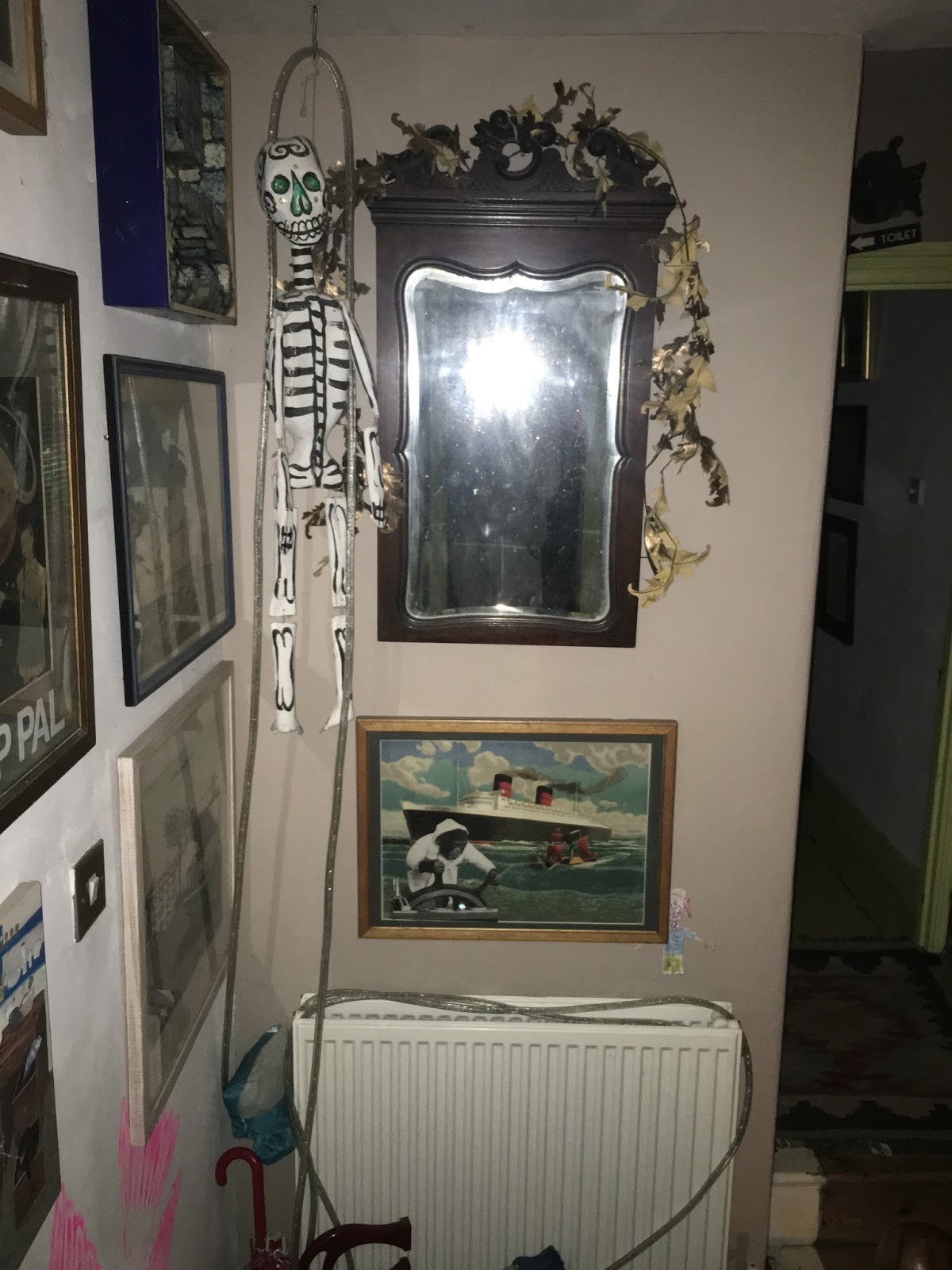
The second hallway has an interesting wooden mirror with ivy on it - this could potentially be used to film a shot from the reflection of the mirror. The style of the mirror and paintings emphasises the rustic aesthetic that typically is associated with the horror genre.
Hallway #2

 The Mural


Although the mural is an interesting aspect of the art studio, its lively aesthetic is unlikely to do us any favours in terms of filming a horror opening.

The Spare Bedroom

The spare bedroom features a large mirror, which again could be used for an interestingly angled shot. I also am keen on the lampshade, which is very rustic. With a low key lighting set up, I think that the furniture in this room could really have an eerie feel to it, as the paintings on the walls and the ubiquitous patina have a very captivating aesthetic. This style of decor is commonly associated with the horror genre, so fits well with the codes and conventions of horror.


Overall, I think we could definitely take some interesting shots from this building, however it is unlikely we will use it as our main focal location. We could also borrow some of the interesting props and transport them to an alternative location.


Tuesday, 20 December 2016

Film Certification

Film age ratings

U: Universal age rating 

  • suitable for all audiences ages four and over
  • set within a positive framework
  • should contain reassuring counterparts to any violence or discrimination
  • no references to drugs, sex, violence, nudity or antisocial behaviour

PG: Parental Guidance

  • general viewing,  but some scenes may be unsuitable for children
  • discrimination is very unlikely unless in historical context
  • no reference to drugs unless they carry an anti-drug message
  • No glamorising imitable behaviour
  • Mild violence is acceptable
12A & 12: Suitable for 12 & over
  • misuse of drugs must be limited and infrequent
  • no promotion of imitable behaviour either 
  • strong language may be allowed but not too frequent or too explicit
15: Suitable for 15 & over
  • The work as a whole must not encourage discriminatory language or behaviour, even though there may be homophobic or racist themes
  • Sexual activity may be shown but not in strong detail. May be strong verbal references to sexual behaviour but the strongest references are unlikely to be acceptable unless justified.
  • The violence shown may be strong but not prolong the pain or injury. Strong gory images are unlikely to be acceptable and the same goes for sadistic violence.

18: Suitable for 18 & over

  • Clear images of real sex, strong fetish material, sexually explicit animated images, or other very strong sexual images will be allowed and will be confined to the R18 category

R18: Restricted 18 

  • Restricted 18 films are only to be shown in specially licensed cinemas, or supplied only in licensed sex shops, and to adults only
  • The R18 category is a special and legally-restricted classification primarily for explicit works of consenting sex or strong fetish material involving adults.

Friday, 16 December 2016

The Rule of Thirds

Research on the Rule of Thirds

When shooting scenes for our film opening, we want to maximise the effectiveness of each and every shot. The rule of thirds is a theory divised to ensure that each shot is appealing to the eye, as well as keeping its symmetry and balance. The rule of thirds applies both within photography and film.

An image composed with the rule of thirds
The theory is based on scientific research that the human eye automatically and subconsciously gravitates to an insertion point when an image is split into thirds. The theory also states that the main focus and interest of the shot should be situation in the first and second thirds of the shot. The focus of the image can be placed on the right or left hand side, however it must remain within only the two thirds. This is demonstrated in the image above, with the building located within the right hand two-thirds.

How can we apply this to our horror film opening sequence?


  • When shooting over-the-shoulder shots we should ensure to keep the in-focus character within the allocated two thirds.
  • When shooting long-shots of architectural exteriors, we should ensure to keep the building aligned correctly within the thirds.
-Anna Humphreys